
| Porter’s Five Forces is a strategic framework that analyzes the competitive intensity of an industry through five forces: competitive rivalry, supplier power, buyer power, the threat of new entrants, and the threat of substitutes. Together, these forces determine how attractive an industry is and how much profit potential exists for companies operating within it. |
What are Porter’s Five Forces? (Definition & Origin)
Porter’s Five Forces is an industry-level analysis tool. Unlike frameworks that examine a single company, it examines the structure of an entire industry to explain why some industries are consistently more profitable than others, regardless of how well any individual company is run.
The framework was developed by Harvard Business School professor Michael Porter and first published in 1979. It remains one of the most widely taught and applied tools in strategic management more than four decades later.
The five forces framework is rooted in industrial organization economics and identifies the forces that determine the competitive intensity, and therefore the attractiveness, of an industry with respect to long-term profitability.
An unattractive industry is one where these forces collectively push profits toward the level any business could earn with no competitive advantage at all. The most unattractive structure resembles pure competition, where no company can sustain above-average returns.
Why Porter’s Five Forces Looks at Industries, Not Companies
Porter made clear that the five forces framework should be applied at the line-of-business industry level, not at a broader sector level. An industry is defined narrowly: a market where similar or closely related products are sold to the same group of buyers. A company that competes in a single industry needs at least one five forces analysis. A diversified company competing across multiple industries needs a separate analysis for each one, because the competitive structure of each industry can differ dramatically.
This distinction matters because the framework is often misapplied. Analyzing “the technology sector” produces almost no useful insight, since cloud infrastructure, consumer electronics, and enterprise software are entirely different industries with entirely different competitive structures.
Porter’s Five Forces vs Temporary Factors
Porter stressed that the five forces should not be confused with more temporary factors such as short-term industry growth rates or specific government interventions. According to Porter, those are transient conditions, while the five forces represent the permanent structural features of an industry. A booming growth rate might temporarily mask weak underlying industry structure, but the structural forces will reassert themselves once growth slows.
The 5 Forces of Porter’s Five Forces: A Deep Dive
1. Competitive Rivalry
Competitive rivalry examines the intensity of competition among existing companies in an industry. It is often the most visible of the five forces because it shapes day-to-day pricing, marketing, and product decisions.
In an industry where rivalry is intense, companies attract customers by cutting prices aggressively and launching high-impact marketing campaigns. This dynamic erodes margins across the entire industry, even for companies that are individually well-managed. Conversely, where rivalry is minimal and few companies offer comparable products, individual companies retain stronger pricing power and healthier profit margins.
Factors that increase competitive rivalry:
- A large number of competitors of similar size and capability
- Slow industry growth, forcing companies to compete for existing customers rather than capturing new ones
- High fixed costs that pressure companies to maximize volume even at lower prices
- Low product differentiation, making price the primary basis for competition
- High exit barriers that keep struggling competitors in the market longer than they otherwise would stay
Example: The European short-haul airline industry exhibits extremely high competitive rivalry. Ryanair, EasyJet, and Wizz Air compete on near-identical routes with minimal product differentiation, driving fares down to levels that leave little margin for any single carrier.
2. Threat of New Entrants
This force examines how easily new competitors can enter an industry and begin competing for the same customers. Industries with low barriers to entry tend to have lower long-term profitability, because any period of high profits attracts new competitors who erode those margins.
The threat of new entrants has been transformed by AI in recent years, and the effect runs in two directions simultaneously. AI tools dramatically lower barriers to entry for software-based businesses, since a small team can now build products that previously required dozens of engineers. At the same time, AI raises barriers to entry in capital-intensive areas like frontier model training, where the cost of competing can run into hundreds of millions of dollars.
Factors that affect the threat of new entrants:
- Capital requirements needed to enter the industry
- Access to distribution channels
- Government regulation, licensing, and compliance requirements
- Brand loyalty and switching costs faced by customers
- Economies of scale that established players already benefit from
Example: The commercial aircraft manufacturing industry has an extremely low threat of new entrants. The capital requirements, regulatory certification process, and decades of accumulated engineering expertise required to compete with Boeing or Airbus make a new entry virtually impossible for any new company.
3. Threat of Substitutes
The threat of substitutes examines products or services from outside the industry that can fulfill the same customer need. Substitutes differ from direct competitors because they come from an entirely different category but serve the same underlying purpose.
The threat of substitutes is perhaps the force most transformed by AI in the current environment. Services that were previously considered non-substitutable, including certain types of legal advice, medical diagnosis support, and creative design work, now face credible AI-powered alternatives that did not exist even a few years ago.
Factors that increase the threat of substitutes:
- Lower price or better performance from the substitute
- Low switching costs for customers moving to the substitute
- Customer willingness to change established habits or behaviors
- The substitute solving the same core problem through a fundamentally different approach
Example: Video conferencing software is a substitute for business air travel. As remote collaboration tools improved, a portion of corporate travel demand that previously went to airlines shifted permanently to video calls, representing a substitute threat that the airline industry could not directly compete against.
4. Bargaining Power of Buyers
This force examines how much influence customers have over pricing and terms. When buyers have significant power, they can negotiate lower prices, demand higher quality, or push for additional services without paying more.
Factors that increase buyer power:
- A small number of large buyers purchasing a significant share of the total industry output
- Low switching costs for buyers moving between suppliers
- Buyers having access to full information about pricing and alternatives
- The product representing a significant portion of the buyer’s total costs, making price sensitivity high
- The ability of buyers to backward integrate and produce the product themselves
Example: Large retail chains have significant bargaining power over consumer goods manufacturers. A retailer that represents a significant share of a manufacturer’s total sales volume can negotiate pricing terms that smaller retailers could never achieve, directly compressing the manufacturer’s margins.
5. Bargaining Power of Suppliers
This force examines how much influence suppliers have over the companies that purchase their inputs. When suppliers have significant power, they can raise prices, reduce quality, or limit availability without losing customers, because alternatives are scarce.
The bargaining power of suppliers has become newly concentrated in certain technology supply chains, particularly around GPU manufacturers and major cloud infrastructure providers. Any AI-powered business today depends on a small number of suppliers for the computing infrastructure that underpins its entire product, giving those suppliers substantial leverage over pricing and access.
Factors that increase supplier power:
- A small number of suppliers serving a large number of buyers
- High switching costs for buyers moving to alternative suppliers
- Suppliers offering products that are highly differentiated or difficult to substitute
- The threat of suppliers integrating forward into the buyer’s industry
- The buying industry representing only a small portion of the supplier’s overall revenue
Example: Airlines depend on a small number of aircraft engine manufacturers, including Rolls-Royce, General Electric, and Pratt & Whitney. When one of these manufacturers experiences a quality or supply issue, airlines have extremely limited ability to switch suppliers in the short term, giving the manufacturers significant leverage over maintenance contracts and pricing.
How to Conduct a Porter’s Five Forces Analysis: Step by Step
Step 1: Define the Industry Precisely
Before analyzing anything, define the specific industry being examined. Be as narrow as the competitive reality requires. “Retail” is too broad. “Online grocery delivery in a specific metropolitan area” is precise enough to produce a meaningful analysis.
The average Fortune Global 1,000 company competes in 52 industries, which means a single five forces analysis for a large diversified company tells you almost nothing useful. Each business unit operating in a distinct industry needs its own analysis.
Step 2: Gather Data for Each of the Five Forces
For each force, collect evidence rather than relying on impressions. Useful sources include industry reports, competitor financial filings, supplier and customer concentration data, and recent merger or entry activity in the industry.
Avoid the trap of superficial analysis, where insufficient effort to understand the underlying reasons behind surface-level observations undermines the entire exercise. “Competition is intense” is an observation. “Three competitors hold 70% combined market share and compete primarily on price due to commoditized products” is an analysis.
Step 3: Rate Each Force as High, Medium, or Low
After gathering evidence, rate each of the five forces. A high rating for a force generally means that the force works against industry profitability. Low competitive rivalry, low buyer power, low supplier power, low threat of substitutes, and low threat of new entrants together describe a highly attractive industry structure.
Step 4: Identify Which Forces Are Most Significant
Not all five forces carry equal weight in every industry. In some industries, supplier power dominates the competitive dynamic. In others, the threat of substitutes is the defining issue. Identify the one or two forces that most strongly shape profitability in the specific industry being analyzed, and focus strategic attention there.
Step 5: Translate Findings into Strategic Positioning
Companies should position themselves where forces are weakest, exploit changes in the forces, and design those forces to their advantage. This is the step many analyses skip. Identifying that an industry has high supplier power is only useful if it leads to a specific response, such as vertical integration, long-term supply contracts, or diversifying the supplier base.
Step 6: Engage Stakeholders in the Analysis
Failing to involve stakeholders during the competitive analysis can lead to avoidable strategic blind spots. Sales teams often have direct insight into buyer power dynamics. Procurement teams understand supplier relationships in detail. Including these perspectives produces a more accurate and more actionable analysis than a purely desk-based exercise.
Step 7: Revisit the Analysis as Industry Conditions Change
Industry structures are not permanent. The static nature of the original framework is one of its most significant limitations, particularly as technological change, regulatory shifts, and disruptive new business models reshape industries faster than they did when the framework was developed in 1979. Schedule a regular review of the analysis, particularly in industries experiencing rapid technological change.
Free Porter’s Five Forces Template
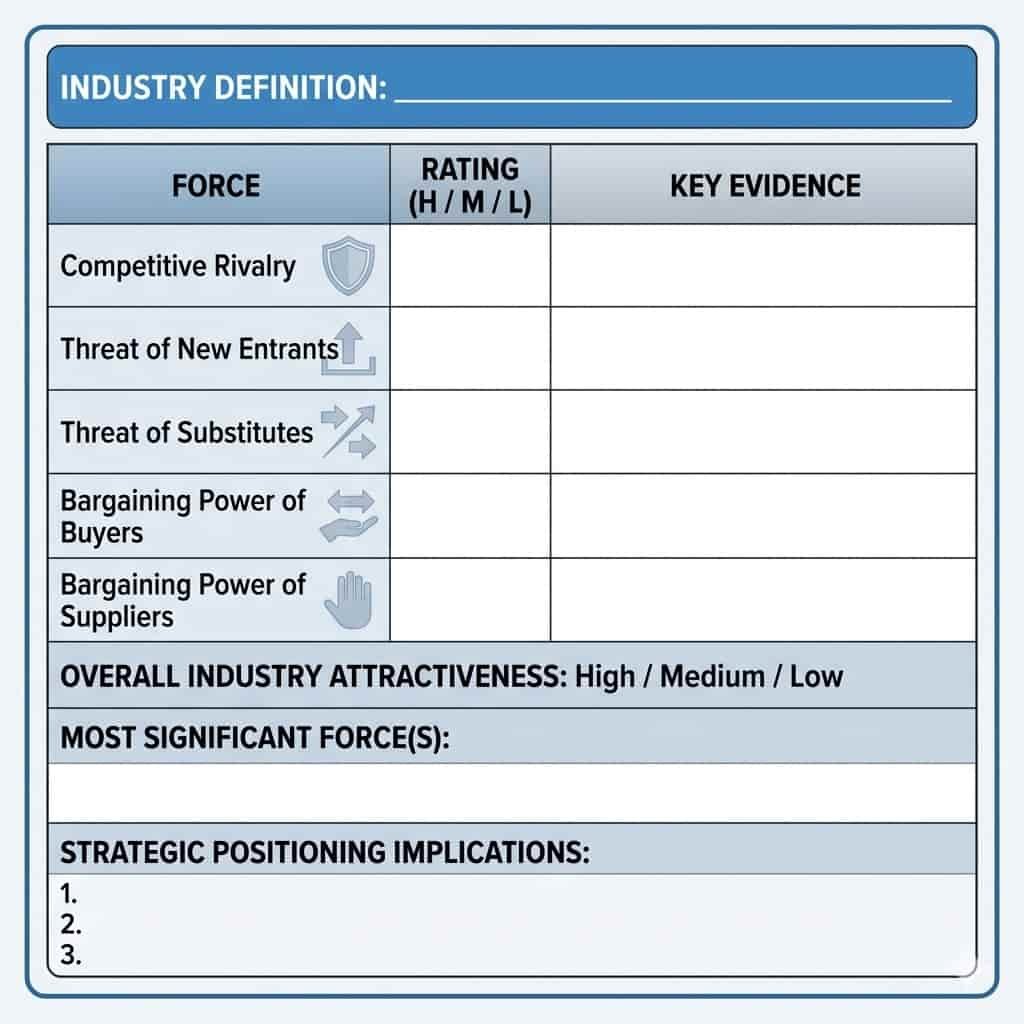
Use this template to structure your industry analysis.
How to Fill In the Template
- Industry definition: Be specific enough that a competitor reading this definition would recognize exactly which companies compete in this space and which do not.
- Rating each force: Use evidence, not impressions. A “high” rating for a force should be backed by specific data such as market share concentration, switching cost estimates, or recent entry and exit activity.
- Overall industry attractiveness: This is a synthesis of all five ratings, not a simple average. One severely unfavorable force can outweigh four favorable ones if it is structurally dominant in the industry.
- Most significant force(s): Identify which forces actually drive the competitive dynamics that matter for strategy. This is where the analysis becomes useful rather than purely descriptive.
- Strategic positioning implications: For each significant force, write a specific response. “Supplier power is high” should lead to an implication such as “diversify supplier base across three regions within 18 months” rather than remaining a general observation.
Porter’s Five Forces Examples (Real-World Industry Applications)
1. Porter’s Five Forces Example: Commercial Airline Industry
Competitive Rivalry: High. Numerous airlines compete on overlapping routes, particularly in Europe and North America, with limited product differentiation in economy class driving intense price competition.
Threat of New Entrants: Low. Capital requirements for aircraft, slot access at major airports, regulatory certification, and brand-building costs make new entry extremely difficult, particularly on long-haul routes.
Threat of Substitutes: Medium. High-speed rail substitutes for short-haul routes in regions with developed rail infrastructure. Video conferencing substitutes for a portion of business travel demand.
Bargaining Power of Buyers: Medium to High. Individual leisure travelers have low switching costs and high price sensitivity, particularly on routes served by multiple carriers. Corporate travel buyers with large contracts have significant negotiating leverage.
Bargaining Power of Suppliers: High. A small number of aircraft manufacturers (Boeing, Airbus) and engine manufacturers (Rolls-Royce, GE, Pratt & Whitney) give suppliers substantial leverage, particularly during periods of supply chain disruption.
Overall Industry Attractiveness: Low to Medium. The airline industry has historically struggled to generate consistent above-average returns due to the combination of high supplier power, intense rivalry on overlapping routes, and price-sensitive buyers. Carriers that succeed typically do so through cost leadership, premium differentiation, or strong loyalty programs that reduce buyer power.
For a detailed application of these dynamics to a specific carrier, our British Airways SWOT analysis examines how one airline navigates exactly these competitive forces, including supplier constraints from Rolls-Royce engines and intense rivalry from both low-cost and Middle Eastern carriers.
2. Porter’s Five Forces Example: Cloud Computing Industry
Competitive Rivalry: Medium to High. The market is dominated by a small number of large providers (AWS, Microsoft Azure, Google Cloud) that compete aggressively on price, performance, and service breadth.
Threat of New Entrants: Low. The capital required to build global data center infrastructure at a competitive scale represents an enormous barrier. Most new entrants compete as resellers or specialized niche providers rather than direct infrastructure competitors.
Threat of Substitutes: Low. On-premise infrastructure is the primary substitute, but the cost and operational advantages of cloud infrastructure have made this an increasingly weak substitute for most use cases.
Bargaining Power of Buyers: Low to Medium. Smaller customers have minimal negotiating leverage and face significant switching costs once workloads are built on a specific provider’s services. Large enterprise customers with multi-million dollar contracts have meaningful leverage.
Bargaining Power of Suppliers: High. Suppliers of GPU hardware and specialized chips have become a critical dependency for cloud providers themselves, particularly as AI workloads drive demand for specialized computing capacity that only a few manufacturers can produce.
Overall Industry Attractiveness: Medium to High for established players with scale, but Low for any new entrant attempting to compete at the infrastructure layer.
3. Porter’s Five Forces Example: Streaming Entertainment Industry
Competitive Rivalry: High. The rise of streaming services has drastically altered the entertainment industry, with numerous platforms competing for the same subscriber base through original content investment and pricing strategy.
Threat of New Entrants: Medium. Technology barriers to launching a streaming platform are relatively low, but the content licensing and production costs required to compete for subscribers represent a significant barrier.
Threat of Substitutes: High. Free ad-supported platforms, social media video content, gaming, and traditional broadcast television all compete for the same consumer attention and time.
Bargaining Power of Buyers: High. Low switching costs allow consumers to subscribe and cancel services with minimal friction, and the proliferation of platforms gives consumers significant choice.
Bargaining Power of Suppliers: Medium to High. Major content studios and sports leagues hold significant leverage over streaming platforms, as exclusive content rights are a primary driver of subscriber acquisition and retention.
Overall Industry Attractiveness: Low to Medium. High rivalry combined with high buyer power and significant supplier leverage from content owners creates a challenging environment where sustained profitability has proven difficult even for large, well-funded platforms.
Porter’s Five Forces vs Other Strategic Frameworks: When to Use Which
1. Porter’s Five Forces vs SWOT Analysis
SWOT examines a single company’s internal strengths and weaknesses alongside external opportunities and threats. Porter’s Five Forces examines the competitive structure of an entire industry, independent of any single company’s specific situation.
The two frameworks complement each other directly. A company’s SWOT analysis can use Porter’s Five Forces to add rigor to its Opportunities and Threats quadrants, since industry-level forces often represent the most significant external factors a company faces.
For a complete walkthrough of SWOT, including the TOWS matrix that converts analysis into strategy, see our SWOT analysis guide.
2. Porter’s Five Forces vs PESTLE Analysis
PESTLE examines macro-environmental factors across Political, Economic, Social, Technological, Legal, and Environmental categories. These factors operate above the industry level and affect every industry within a market, though the magnitude of impact varies.
Porter’s Five Forces operates at the industry level, examining the specific competitive structure within that broader macro-environment. The two frameworks pair naturally: PESTLE explains the external context shaping an industry, while Porter’s Five Forces explains how that context translates into competitive dynamics within the industry itself. For the full breakdown of all six PESTLE factors, see our PESTLE analysis guide.
3. Porter’s Five Forces vs VRIO Framework
Porter’s external industry analysis and Barney’s internal resource analysis are often described as complementary halves of a complete strategic picture. Porter’s Five Forces tells a company how attractive its industry is structurally. VRIO tells a company whether its specific internal resources can generate a competitive advantage regardless of the broader industry structure.
A company operating in a structurally unattractive industry, as defined by Porter’s Five Forces, can still achieve above-average returns if it holds resources that pass the full VRIO test: valuable, rare, costly to imitate, and supported by an organization capable of exploiting them.
For the full framework on evaluating internal resources, see our VRIO framework guide.
Porter’s Five Forces vs BCG Matrix
The BCG Matrix categorizes a company’s existing products or business units by market share and market growth rate. Porter’s Five Forces examines the competitive structure surrounding those products or business units.
A product classified as a Star in the BCG Matrix exists within an industry that Porter’s Five Forces might reveal to be structurally challenging, with high rivalry or significant buyer power limiting how much value that Star can ultimately capture. Running both analyses together gives a more complete picture than either alone.
For examples of the BCG Matrix applied to real companies, see our Business Analysis and Modeling section.
Common Mistakes When Using Porter’s Five Forces
Mistake 1: Defining the Industry Too Broadly
Analyzing “the technology industry” or “retail” produces conclusions so general that they cannot inform any specific strategic decision. The framework is designed for line-of-business industry analysis, not sector-wide generalizations.
- Fix: Define the industry narrowly enough that a competitor reading the definition would immediately recognize which companies are included and which are not.
Mistake 2: Surface-Level Observations Without Underlying Analysis
Insufficient effort to uncover the underlying reasons behind observations undermines the entire analysis. Stating that “competition is intense” without explaining why, through market share concentration, product differentiation levels, or cost structures, produces an analysis that cannot guide strategy.
- Fix: For every rating, require a specific evidentiary explanation. “High” or “low” alone is insufficient.
Mistake 3: Treating the Analysis as a One-Time Exercise
The static nature of the original framework is a frequently cited limitation, particularly as technology, regulation, and consumer behavior reshape industries faster than the framework’s 1979 origins anticipated. An analysis completed several years ago may no longer reflect the current competitive structure.
- Fix: Schedule periodic reviews, particularly in industries experiencing rapid technological disruption.
Mistake 4: Stopping at Description Instead of Strategic Implication
The framework is intended to inform business strategy, not merely to assess industry attractiveness. A team that completes a thorough five forces analysis and stops there has produced a description, not a strategy.
- Fix: For every significant force identified, require an explicit strategic response: a specific action the company will take in response to that force.
Mistake 5: Ignoring Interactions Between Forces
Some critics argue the framework’s assumptions are dubious because buyers, competitors, and suppliers are treated as unrelated and non-interacting groups, when in reality these groups often collude, integrate, or influence each other in ways the basic framework does not capture.
- Fix: After completing individual force analysis, consider how the forces interact. A supplier with high bargaining power might also be a potential new entrant if it chooses to integrate forward into your industry.
Limitations of Porter’s Five Forces
Honest strategic practice requires acknowledging where the framework falls short.
1. It Assumes a Relatively Static Industry Structure
The model assumes that industry structures remain stable over time, but technological advancements, disruptive innovation, and shifting consumer behavior can transform an industry’s competitive structure far faster than the framework’s original design anticipated. Streaming services reshaping entertainment and ride-sharing reshaping transportation are examples of disruptions that the static model struggles to anticipate.
2. It is Company-Agnostic
The framework is centered on sector-level insights, and findings require interpretation relative to each specific company’s situation and strategic intent. The same industry-level forces affect different companies within that industry to different degrees depending on their specific positioning, resources, and scale.
3. It Can Encourage Over-Reliance on Qualitative Judgment
Quantifying the interplay between forces, such as supplier margins or buyer churn rates, requires deliberate effort that many analyses skip in favor of high, medium, or low ratings based on general impression rather than measurable data.
4. The Framework’s Underlying Assumptions Have Been Challenged
Some strategists argue that the framework assumes buyers, competitors, and suppliers operate independently without interaction or collusion, an assumption that does not hold in many real industries where vertical integration, strategic alliances, and informal coordination are common.
5. It Does Not Fully Account For Complements
Products that increase the value of each other, such as a car and gasoline, or a smartphone and its app ecosystem, influence industry dynamics in ways the original five forces do not directly capture. Some analysts treat complements as an unofficial sixth force, though Porter himself maintained that complements influence the existing forces rather than forming an independent structural element.
Frequently Asked Questions
What are Porter’s Five Forces?
Porter’s Five Forces are competitive rivalry, the threat of new entrants, the threat of substitutes, the bargaining power of buyers, and the bargaining power of suppliers. Together, these forces determine the competitive intensity and overall profitability potential of an industry.
Who created Porter’s Five Forces?
Porter’s Five Forces was developed by Harvard Business School professor Michael E. Porter and first published in 1979. It remains one of the most widely used frameworks in strategic management.
What is the purpose of a Porter’s Five Forces analysis?
The purpose is to assess how attractive an industry is by examining the structural forces that determine long-term profitability potential. The analysis helps companies understand where to compete, how to position themselves relative to competitive pressures, and which structural forces to target for strategic advantage.
How do you conduct a Porter’s Five Forces analysis step by step?
Define the industry precisely at the line-of-business level. Gather evidence for each of the five forces. Rate each force as high, medium, or low based on that evidence. Identify which forces most significantly shape profitability in this specific industry. Translate findings into specific strategic positioning decisions. Engage relevant stakeholders throughout. Revisit the analysis periodically as industry conditions change.
What is the difference between Porter’s Five Forces and SWOT analysis?
SWOT examines a single company’s internal strengths and weaknesses alongside external opportunities and threats. Porter’s Five Forces examines the competitive structure of an entire industry, independent of any one company. The two frameworks work well together, with Porter’s Five Forces adding industry-level rigor to a SWOT analysis’s external factors.
What is the difference between Porter’s Five Forces and PESTLE analysis?
PESTLE examines macro-environmental factors (Political, Economic, Social, Technological, Legal, and Environmental) that affect every industry within a broader market. Porter’s Five Forces examines the specific competitive structure within a single industry. PESTLE provides the macro context; Porter’s Five Forces explains how that context plays out competitively within a defined industry.
Is Porter’s Five Forces still relevant in 2026?
Yes, though it requires an updated application. AI has reshaped each of the five forces in significant ways: lowering barriers to entry for software businesses while raising them for capital-intensive AI infrastructure, concentrating supplier power among GPU and cloud providers, and creating new substitute threats for services previously considered non-substitutable. The underlying logic of the framework remains sound, but each force needs to be re-examined through the lens of current technological and market conditions.
What are the main limitations of Porter’s Five Forces?
The main limitations include its static assumption that industry structures remain stable, its company-agnostic nature that requires interpretation for specific firms, its tendency to encourage qualitative impressions over measurable data, challenges to its assumption that buyers, suppliers, and competitors act independently, and its incomplete treatment of complementary products that some analysts consider an unofficial sixth force.
Conclusion
Porter’s Five Forces remains a foundational tool for understanding why some industries are structurally more profitable than others, regardless of how skillfully any individual company operates within them. By examining competitive rivalry, the threat of new entrants, the threat of substitutes, and the bargaining power of both buyers and suppliers, companies gain a clear view of the structural forces shaping their long-term profitability potential.
The framework works best when applied at a precise industry level, supported by genuine evidence rather than impressions, and revisited regularly as technology and market conditions evolve. Used alongside internal frameworks like VRIO and macro-level tools like PESTLE, Porter’s Five Forces forms one essential piece of a complete strategic picture rather than a standalone verdict.
To explore how this framework connects to the broader strategy toolkit, see our SWOT analysis guide for combining internal and external factors, our PESTLE analysis guide for the macro-environmental forces surrounding any industry, our VRIO framework guide for evaluating internal resources independent of industry structure, and our Business Analysis and Modeling section for real company applications across industries.