| The VRIO framework is a strategic analysis tool that evaluates whether a company’s internal resources can generate a sustained competitive advantage. VRIO stands for Value, Rarity, Imitability, and Organization. Businesses use it to identify which capabilities truly set them apart from rivals and which ones offer no lasting edge at all. |
What Is the VRIO Framework? (Definition & Origin)
The VRIO framework is a resource-based analysis tool that asks four sequential questions about any internal resource or capability. Does it create value? Is it rare among competitors? Is it hard to imitate? And is the organization structured to use it effectively?
The VRIO framework was introduced as VRIN by Jay Barney in his 1991 paper, which became one of the foundational texts of the resource-based view of the firm. The original acronym stood for Valuable, Rare, Inimitable, and Non-substitutable. Barney and Hesterly later replaced the “N” with “O” for Organization in 2012, reasoning that non-substitutability is really a subset of imitability. If a competitor finds a substitute resource that achieves the same outcome, that substitute is itself a form of imitation.
The framework belongs to a broader school of thought called the resource-based view (RBV), which argues that competitive advantage comes from what is inside a company, not just from its position in the market. This sets VRIO apart from external-facing frameworks like Porter’s Five Forces, which focus on industry structure rather than internal capabilities.
Why VRIO Comes After SWOT, Not Before
A common mistake is running VRIO as a standalone exercise. Before using the VRIO framework, a company should complete a SWOT analysis first to identify its current strengths. VRIO then takes those strengths and tests them more rigorously. SWOT tells you what you believe your strengths are. VRIO tells you which of those strengths can actually protect your market position over time.
Running VRIO on every resource a company has is impractical. The better approach is to take the strongest candidates from a SWOT analysis and put only those through the VRIO test. For a full walkthrough of how to identify strengths before applying VRIO, see our complete SWOT analysis guide.
The 4 Components of the VRIO Framework: A Deep Dive
1. Value: Does the Resource Create Value?
The first question in any VRIO analysis is whether the resource allows the company to exploit an opportunity or neutralize a threat in its external environment. A resource that does neither is strategically valuable, no matter how impressive it looks on paper.
Value must be defined externally, by market demand, not by internal belief. A factory that produces a product nobody wants is not valuable simply because it exists. A resource only passes this stage if it contributes directly to lower costs, higher revenue, improved customer experience, or some other outcome the market actually rewards.
Questions to ask:
- Does this resource help us respond to customer needs better than before?
- Does it reduce our costs in a way that customers or investors value?
- Does it allow us to capture an opportunity our competitors cannot currently capture?
If the answer to all of these is no, the resource fails the VRIO test immediately and does not need to be evaluated further.
2. Rarity: Is the Resource Rare?
If a resource is valuable but every competitor in the industry also has it, the resource cannot be a source of competitive advantage. It may be necessary just to compete, but it cannot explain why one company outperforms another.
Rarity does not mean the resource has to be completely unique. It means the resource is held by few enough competitors that its possession creates a meaningful gap in capability. A skilled workforce is valuable to almost every company, but if every competitor in an industry has equally skilled staff, that workforce is not rare in the VRIO sense.
Examples of resources that often pass the rarity test:
- Proprietary technology or patented processes
- Exclusive long-term supplier or distribution agreements
- A specific organizational culture that took decades to build
- Access to scarce raw materials or unique geographic locations
3. Imitability: Is the Resource Costly to Imitate?
This is usually the most decisive criterion in the entire framework. A resource can be valuable and rare, but if a competitor can replicate it quickly and cheaply, any advantage it creates will be temporary.
Resources that are costly to imitate often share one of three characteristics, including:
- Unique historical conditions that cannot be recreated
- Causal ambiguity where competitors cannot determine exactly why the resource works, or
- Social complexity where the resource is embedded in relationships, culture, or trust that took years to build
Time horizons for imitation vary significantly by resource type. Technological resources typically have short half-lives of two to five years, since patents expire and engineering talent moves between companies. Socially complex resources such as company culture, tacit knowledge, and relationship networks can have half-lives of ten years or more, because they cannot simply be purchased or copied through reverse engineering.
This is why a useful addition to any VRIO analysis is asking not just “is this imitable?” but “how long until this becomes imitable?”
4. Organization: Is the Company Organized to Exploit the Resource?
A resource can pass all three previous tests and still fail to deliver any competitive advantage if the company is not structured to use it. Organization examines whether a company’s management systems, reporting structures, policies, and culture allow it to fully capture the value of its valuable, rare, and hard-to-imitate resources.
A company might own a patent for a breakthrough technology (valuable, rare, hard to imitate) but lack the manufacturing capacity, supply chain relationships, or sales infrastructure to bring it to market effectively. In that case, the resource exists, but the organization cannot exploit it, and the competitive advantage remains theoretical rather than realized.
Organizational factors to evaluate:
- Does management structure support fast decision-making around this resource?
- Are reporting and compensation systems aligned to encourage use of this resource?
- Does company culture support the behaviors needed to maximize this resource’s value?
- Are there formal processes for protecting and reinforcing this resource over time?
How to Conduct a VRIO Analysis: Step by Step
Step 1: Identify Candidate Resources from a Prior SWOT Analysis
Start by listing the internal strengths your organization has already identified through a SWOT analysis. These should be specific and concrete, not vague categories. “Strong brand” is too broad. “Customer loyalty program with a 68% repeat purchase rate” is specific enough to evaluate properly.
Limit your initial list to 5 to 8 candidate resources. Running every internal attribute through VRIO is exhausting and produces diminishing returns. Focus on the resources that appear to differentiate your company most clearly from competitors.
Step 2: Separate Tangible and Intangible Resources
Resources generally fall into two categories. Tangible resources include physical assets like factories, equipment, cash reserves, and proprietary technology infrastructure. Intangible resources include brand reputation, organizational culture, intellectual property, and relationship networks.
Intangible resources more often pass the rarity and imitability tests, because physical assets can usually be purchased by any competitor with sufficient capital. Culture, reputation, and deeply embedded knowledge cannot be bought off the shelf.
Step 3: Apply the Value Test to Each Resource
For each candidate resource, ask whether it genuinely helps the company exploit an opportunity or neutralize a threat. Use external evidence, such as customer feedback, market share data, or financial performance linked to that resource, rather than internal opinion.
Any resource that fails this test should be removed from further analysis. It might still be a useful asset, but it will not be a source of competitive advantage.
Step 4: Apply the Rarity Test
For resources that pass the value test, assess how many competitors possess a comparable resource. This often requires competitive benchmarking. If you do not have direct visibility into competitor capabilities, industry reports, job postings (which reveal what skills competitors are hiring for), and customer reviews of competing products can provide useful signals.
Step 5: Apply the Imitability Test
This is the step that requires the most careful thinking. For each resource that has passed both previous tests, assess how difficult and costly it would be for a well-resourced competitor to replicate it.
Consider the three sources of inimitability: unique historical conditions, causal ambiguity, and social complexity. Estimate a rough “half-life” for the resource, meaning how many years until a determined competitor could plausibly replicate it.
Step 6: Apply the Organization Test
For any resource that has passed the first three tests, assess whether your company’s current structure, systems, and culture allow you to fully use it. If the answer is no, the resource has potential that is currently unrealized. This is a strategically important finding because it points directly to an internal investment priority.
Step 7: Classify Each Resource Using the VRIO Outcomes Table
Once each resource has been tested against all four criteria, classify the result using the table below. This classification becomes the foundation for resource allocation decisions.
| Valuable | Rare | Costly to Imitate | Organized to Exploit | Competitive Implication |
| No | – | – | – | Competitive disadvantage |
| Yes | No | – | – | Competitive parity |
| Yes | Yes | No | – | Temporary competitive advantage |
| Yes | Yes | Yes | No | Unused competitive advantage |
| Yes | Yes | Yes | Yes | Sustained competitive advantage |
VRIO Framework Examples (Real-World Applications)
1. VRIO Analysis Example: Technology Company
Consider a software company evaluating its proprietary recommendation algorithm.
- Value: The algorithm increases user engagement and conversion rates, directly improving revenue. It passes.
- Rarity: Few competitors have an algorithm trained on a comparable volume of proprietary user data. It passes, though the gap is narrowing as competitors accumulate their own data.
- Imitability: A competitor with sufficient capital could build a similar algorithm, but replicating years of accumulated training data would take significant time. This gives the resource a medium imitation half-life, likely three to five years.
- Organization: The company has dedicated data science teams, infrastructure for continuous model retraining, and product teams that integrate algorithm outputs directly into the user experience. It passes.
Conclusion: This resource currently provides a sustained competitive advantage, but the time-limited nature of the imitability factor means the company should treat this as an advantage with an expiration date and continue investing in data accumulation to extend it.
2. VRIO Analysis Example: Manufacturing Company
Consider a manufacturer evaluating its decades-old relationships with a network of specialized component suppliers.
- Value: These relationships allow the company to secure priority access to components during supply shortages, directly protecting production continuity. It passes.
- Rarity: Few competitors have relationships of comparable depth and history with the same supplier network. It passes.
- Imitability: These relationships were built over 30 years through consistent reliability and trust. Socially complex resources of this kind typically have imitation half-lives of ten years or more. It passes strongly.
- Organization: The company has a dedicated supplier relations team and procurement processes built around long-term partnership rather than transactional sourcing. It passes.
Conclusion: This resource represents a sustained competitive advantage with a long expected duration. It is a clear candidate for continued investment and protection, since it is exactly the type of resource competitors cannot quickly replicate, regardless of how much capital they deploy.
3. VRIO Analysis Example: Retail Company
Consider a retailer evaluating its brand reputation for customer service.
- Value: Customer service reputation drives repeat purchases and reduces customer acquisition costs through word of mouth. It passes.
- Rarity: Several competitors in the same category have also built strong service reputations. The resource is valuable but not rare.
Conclusion: This resource provides competitive parity rather than a competitive advantage. It is necessary to remain competitive in the category, but it does not explain why this retailer would outperform similarly positioned rivals. The company should continue investing in customer service to maintain parity, but should look elsewhere for resources that could create genuine differentiation.
Free VRIO Analysis Template
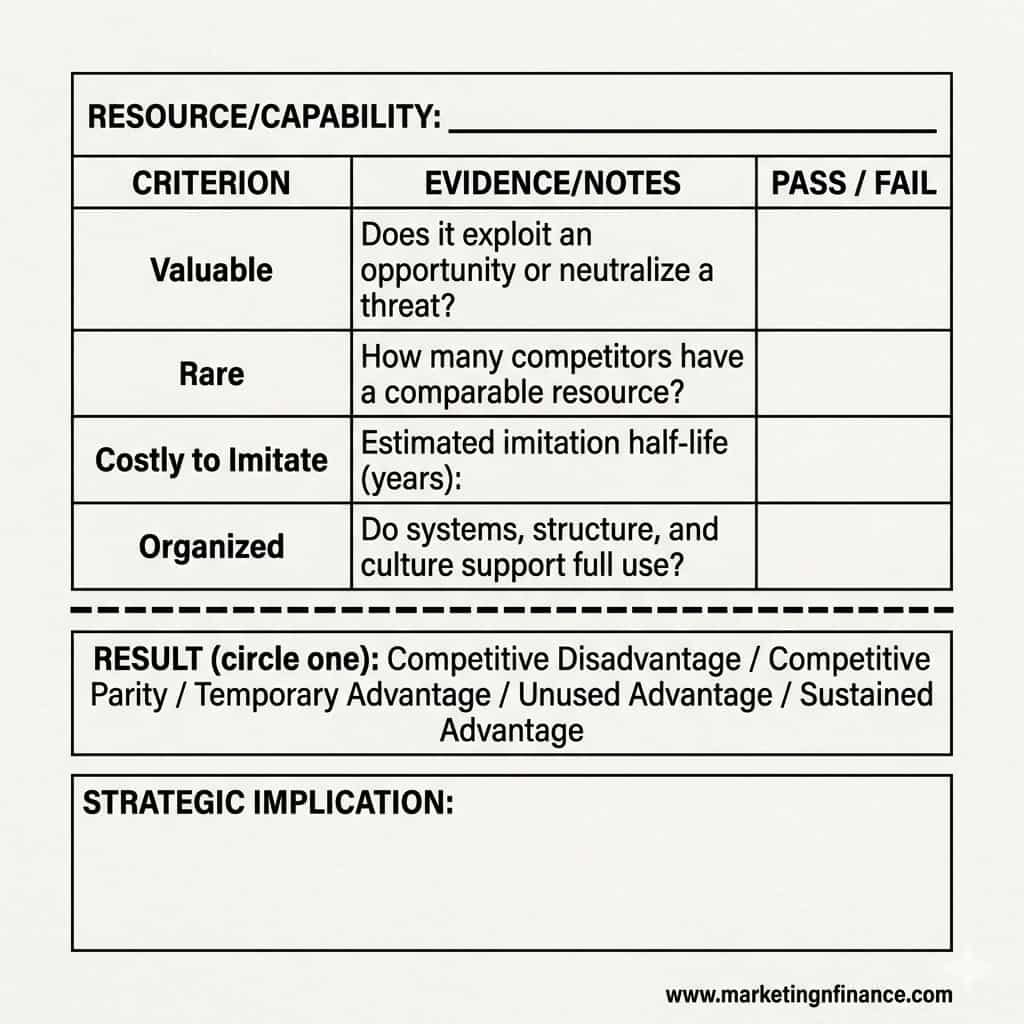
Use this template to evaluate each candidate resource identified from your SWOT analysis.
How to Fill In the Template
Resource/Capability: Be specific. Name the exact resource, not a general category. “Proprietary logistics software reducing delivery times by 30%” is usable. “Good logistics” is not.
Valuable: Cite external evidence such as customer data, sales figures, or market share trends. Internal opinion alone should not pass this test.
Rare: Where possible, base this on competitive benchmarking rather than assumption. If you cannot determine rarity with confidence, mark it as “uncertain” and prioritize further research.
Costly to Imitate: Estimate a realistic timeframe. Be skeptical of any resource you assume is permanently inimitable. Almost everything can eventually be copied; the question is how long it takes.
Organized: This is often the most overlooked criterion. A resource with strong fundamentals delivers no advantage if the company cannot operationally exploit it. If this criterion fails, the strategic implication should focus on organizational investment, not on the resource itself.
VRIO vs Other Strategic Frameworks: When to Use Which
1. VRIO vs SWOT Analysis
SWOT is a broad strengths and weaknesses inventory combined with external opportunities and threats. VRIO is a focused test applied to specific strengths identified through SWOT. SWOT asks “what do we think our strengths are?” VRIO asks “which of these strengths can actually protect our position long term?”
The two frameworks work best in sequence. Complete a SWOT analysis first, then select the strongest internal candidates and run them through VRIO. For a complete walkthrough of the SWOT process, including the TOWS matrix, see our SWOT analysis guide.
2. VRIO vs PESTLE Analysis
PESTLE examines external macro-environmental factors across Political, Economic, Social, Technological, Legal, and Environmental categories. VRIO examines internal resources. The two frameworks address different questions entirely and are not interchangeable.
A resource that passes the VRIO test internally can still be undermined by external factors that PESTLE would identify. A patented technology might be valuable, rare, and hard to imitate, but if new regulations make that technology illegal in a key market, the VRIO classification becomes irrelevant overnight. For a full breakdown of the six PESTLE factors, see our PESTLE analysis guide.
3. VRIO vs Porter’s Five Forces
Porter’s Five Forces analyzes the competitive structure of an entire industry: the bargaining power of suppliers and buyers, the threat of new entrants and substitutes, and rivalry intensity. VRIO analyzes a single company’s internal resources regardless of industry structure.
VRIO sits within a broader academic conversation often described as the “Barney-Porter bridge,” where Porter’s external industry analysis and Barney’s internal resource analysis are seen as complementary halves of a complete strategic picture. An industry might be structurally unattractive according to Porter’s framework, yet a specific company within that industry might still achieve outsized returns if it holds resources that pass the full VRIO test.
4. VRIO vs BCG Matrix
The BCG Matrix categorizes business units or products by market share and market growth rate into Stars, Cash Cows, Question Marks, and Dogs. It is a portfolio management tool focused on where to allocate capital across a company’s existing businesses.
VRIO does not look at portfolio allocation. It looks at whether the underlying resources behind any given business unit can sustain a competitive position. A Star in the BCG Matrix that lacks any VRIO-qualifying resources may be a Star only because of favorable market timing, and that position could erode quickly once competitors catch up. For examples of how the BCG Matrix applies to real companies, see our Business Analysis and Modeling section.
Common VRIO Analysis Mistakes (and How to Fix Them)
Mistake 1: Running VRIO Without a Prior SWOT
Companies that skip straight to VRIO often end up evaluating resources that were never properly identified as strengths in the first place. The result is a VRIO analysis built on assumptions rather than evidence.
Fix: Always begin with a SWOT analysis or equivalent strengths assessment. Use that output as the input list for VRIO.
Mistake 2: Defining “Value” Internally Instead of Externally
A common analytical error is defining value based on internal pride rather than external market demand. A company may believe its manufacturing process is innovative, but if customers do not perceive or care about that innovation, the resource does not create value in the VRIO sense.
Fix: Require external evidence (customer data, sales performance, market research) before marking any resource as valuable.
Mistake 3: Treating Resources as Permanently Inimitable
Many companies assume a resource that has provided an advantage for years will continue to do so indefinitely. This ignores that imitation half-lives vary and that even socially complex resources eventually face erosion as employees move between companies or as markets mature.
Fix: Estimate an explicit imitation timeframe for each resource and revisit the analysis on a schedule, particularly for technology-related resources where the half-life can be as short as two to five years.
Mistake 4: Skipping the Organization Criterion
The Organization criterion is frequently treated as an afterthought, yet it is often where the most actionable findings emerge. A resource that fails this test points directly to an internal investment opportunity.
Fix: Give the Organization test equal weight to the other three criteria. If a valuable, rare, and hard-to-imitate resource fails this test, treat that as a priority finding, not a footnote.
Mistake 5: Evaluating Too Many Resources at Once
Running every organizational attribute through VRIO is exhausting and produces diminishing returns. Teams that attempt this often lose focus and produce shallow analysis across too many items.
Fix: Limit the initial analysis to 5 to 8 of the strongest candidate resources identified through SWOT. Depth matters more than breadth here.
Limitations of the VRIO Framework
Honest strategic practice requires acknowledging where VRIO falls short.
1. The Tautology Problem
Critics, including Priem and Butler, argue that VRIO can be circular: if “valuable” is defined as “leads to competitive advantage,” and the framework’s conclusion is also “competitive advantage,” the analysis risks proving nothing beyond its own definitions. The resolution to this critique is to insist that value be measured through independent external evidence, such as market demand, not through internal reasoning about strategic fit.
2. Subjectivity in Assessment
Determining whether a resource is rare or costly to imitate often involves judgment calls that vary between analysts and between industries. Two teams analyzing the same resource can reach different conclusions depending on how they define “rare” or how they estimate imitation costs.
3. It Assumes a Relatively Stable Environment
VRIO does not account well for rapidly evolving markets where resources that provide sustained advantage today can become irrelevant within a short period due to disruptive technology or shifting consumer behavior.
4. It Neglects External Factors
VRIO focuses entirely on internal resources and does not incorporate external conditions such as regulatory changes, economic shifts, or competitive moves. A resource that passes every VRIO criterion can still be undermined by a single external development the framework was never designed to detect.
5. Sustained Competitive Advantage May Not Be Achievable
In genuinely dynamic markets, any competitive advantage tends to be temporary regardless of how strong the underlying resource appears. Competitors innovate, markets shift, and even the most defensible resources eventually face new forms of competition that the original analysis did not anticipate.
These limitations do not make VRIO useless. They make it a tool that should be applied with explicit time horizons, external validation, and regular review, rather than as a one-time exercise that produces a permanent verdict.
Frequently Asked Questions
What does VRIO stand for?
VRIO stands for Value, Rarity, Imitability, and Organization. These are the four criteria used to evaluate whether an internal resource or capability can provide a company with a sustained competitive advantage.
Who created the VRIO framework?
The VRIO framework originated from Jay Barney’s 1991 paper on the resource-based view, which introduced the VRIN framework (Valuable, Rare, Inimitable, Non-substitutable). Barney and Hesterly later updated it to VRIO in 2012, replacing “Non-substitutable” with “Organization.”
What is the difference between VRIO and SWOT?
SWOT identifies a broad list of strengths, weaknesses, opportunities, and threats. VRIO takes the strengths identified by a SWOT analysis and tests them more rigorously against four specific criteria to determine which ones can actually sustain a competitive advantage over time.
How do you conduct a VRIO analysis step by step?
Identify candidate resources from a prior SWOT analysis. Separate tangible and intangible resources. Apply the value test using external evidence. Apply the rarity test through competitive benchmarking. Apply the imitability test and estimate an imitation timeframe. Apply the organization test to assess whether the company can exploit the resource. Classify each resource using the VRIO outcomes table.
What is the difference between VRIO and VRIN?
VRIN was the original 1991 version of the framework, standing for Valuable, Rare, Inimitable, and Non-substitutable. VRIO replaced “Non-substitutable” with “Organization” in 2012, because non-substitutability was considered a subset of imitability, while Organization added a missing dimension about whether the company could actually exploit the resource.
What are the main limitations of the VRIO framework?
The main limitations include the tautology critique (the framework can be circular if value is defined as leading to competitive advantage), subjectivity in determining rarity and imitability, an assumption of relatively stable markets, neglect of external factors that PESTLE or Porter’s Five Forces would capture, and the broader question of whether truly sustained competitive advantage is achievable in dynamic markets at all.
Can VRIO be used alongside Porter’s Five Forces?
Yes. VRIO and Porter’s Five Forces analyze different dimensions of strategy and work well together. Porter’s Five Forces examines the external competitive structure of an industry, while VRIO examines a specific company’s internal resources. A company can hold VRIO-qualifying resources that allow it to outperform even in a structurally unattractive industry as defined by Porter’s framework.
Conclusion
The VRIO framework gives businesses a disciplined way to separate genuine sources of competitive advantage from resources that simply look impressive. By testing each resource against value, rarity, imitability, and organization, companies can focus investment on the capabilities that will actually protect their market position over time.
The framework works best as a second step, applied after a SWOT analysis has identified candidate strengths, and used with explicit timeframes rather than permanent verdicts. A resource that passes all four criteria today may not pass them in five years, and building that expectation into the analysis from the start produces far more useful strategic guidance.
To see how VRIO connects to the broader strategy toolkit, explore our SWOT analysis guide for identifying candidate resources, our PESTLE analysis guide for the external factors VRIO does not cover, and our Business Analysis and Modeling section for real company applications of these frameworks across industries.