
| A PESTLE analysis is a strategic framework that scans six macro-environmental forces outside your organization: Political, Economic, Social, Technological, Legal, and Environmental factors. It gives leaders a structured view of the external conditions shaping their industry. Teams use it before entering new markets, launching products, or building long-term strategy so no major external force goes unnoticed. |
What Is a PESTLE Analysis? (Definition & Origin)
A PESTLE analysis is a macro-environmental scanning tool. Unlike internal frameworks, it focuses entirely on forces outside the organization that you cannot control but must understand and respond to. The six factors together form a complete picture of the wider business environment in which any organization operates.
According to research, 93% of Fortune 500 companies use PESTLE analysis as part of their strategic planning process. That adoption rate is not surprising. In a world of shifting trade policy, rapid technological change, and tightening environmental regulation, operating without a structured external scan is a strategic blind spot.
Where Did PESTLE Analysis Come From?
PESTLE evolved from an earlier and simpler tool called PEST analysis, which only covered Political, Economic, Social, and Technological factors. As organizations recognized that legal compliance and environmental sustainability were becoming independent strategic forces rather than subsets of politics, the framework expanded to include the L (Legal) and E (Environmental) factors.
Today you will see several spellings in use: PESTLE, PESTEL, PEST, STEEP, and STEEPLE. They all refer to variations of the same external scanning concept. The order of the letters changes but the underlying logic does not.
PESTLE vs PEST: What Is the Difference?
PEST covers four factors: Political, Economic, Social, and Technological. PESTLE adds Legal and Environmental. The expanded version is more appropriate for modern business environments where regulatory compliance and climate-related risks carry significant strategic weight. Most strategic planning professionals now default to PESTLE over the original PEST framework for exactly this reason.
The 6 Factors of PESTLE Analysis: A Deep Dive
1. Political Factors in PESTLE Analysis
Political factors cover how government decisions, policies, and instability can affect your business. This includes both the country you operate in and any country you trade with or source materials from.
Key political factors to assess include:
- Government stability and continuity of economic policy
- Trade tariffs, import restrictions, and export regulations
- Tax policy changes affecting corporate profits or consumer spending
- Subsidies and government support programs for specific industries
- Geopolitical risks and international relations between trading partners
- Government regulations on specific industry sectors
A critical mistake many teams make here is limiting political analysis to their home country’s national government. In practice, regional bodies like the European Union often have more direct impact on business than national governments, particularly on data protection, product standards, and trade policy.
Example: A retail brand sourcing goods from Southeast Asia must track trade tariff policy in both the US and EU markets simultaneously. A sudden change in import duties can shift cost structures overnight and make a previously profitable supply chain unviable.
2. Economic Factors in PESTLE Analysis
Economic factors cover the macro-economic conditions in any market your business operates in or sells to. These conditions directly affect consumer spending power, production costs, and the viability of your business model.
Key economic factors to assess include:
- GDP growth rate and economic expansion or contraction
- Inflation rates and their effect on consumer purchasing power
- Interest rates set by central banks affecting borrowing costs
- Exchange rates for businesses trading across currencies
- Unemployment levels and their impact on labor supply and wages
- Consumer confidence and disposable income trends
Economic conditions in key markets affect consumer purchasing power directly. During economic downturns or periods of high inflation, consumers reduce discretionary spending, which affects sales volume across most product categories.
One area many guides underemphasize is the interaction between economic and political factors. Central bank interest rate decisions are simultaneously economic and politically driven. Tariff policy changes are simultaneously political decisions with direct economic consequences. Analyzing these in isolation produces incomplete insight.
3. Social Factors in PESTLE Analysis
Social factors examine the demographic, cultural, and behavioral trends that shape consumer demand and workforce dynamics. These tend to move slowly but carry significant long-term strategic weight.
Key social factors to assess include:
- Population growth, age distribution, and demographic shifts
- Cultural values and changing consumer attitudes
- Education levels and their influence on both workforce skills and consumer behavior
- Health consciousness and lifestyle trends affecting product demand
- Social attitudes toward sustainability, corporate responsibility, and ethics
- Urbanization trends and shifts in where populations concentrate
Fully understanding the social environment within which you operate helps you identify both risks and opportunities perhaps missed by competitors. A brand targeting millennials today must understand that this cohort places significantly higher value on brand ethics and environmental credentials than previous generations did at the same age.
Example: The rapid growth of plant-based food brands was primarily a social factor. Consumer attitudes toward health, animal welfare, and environmental impact shifted first. Businesses that tracked those social signals early were positioned to capture the market before it peaked.
4. Technological Factors in PESTLE Analysis
Technological factors cover the rate of innovation and digital disruption that affects how businesses operate, compete, and deliver value to customers.
Key technological factors to assess include:
- Rate of technological change and product obsolescence cycles
- Automation and its impact on labor requirements and production costs
- Digital infrastructure and internet penetration in target markets
- Research and development activity across your industry
- Cybersecurity risks and data protection requirements
- Adoption of artificial intelligence, machine learning, and automation tools
A common mistake is defining technological factors too broadly as “digitalization.” The relevant question is not what is technically possible, but which specific technologies are changing competitive dynamics in your industry. A manufacturing company’s technological environment looks entirely different from a financial services company’s even if both are affected by AI.
Technological factors do not stay in their own lane. Political decisions around technology affect economic conditions. Technological shifts create new legal questions. The EU AI Act, for example, is a legal framework built entirely in response to a technological development.
5. Legal Factors in PESTLE Analysis
Legal factors cover the current laws and regulations that govern how your business must operate. This is distinct from political factors, which look at potential future policy changes. Legal factors deal with what is already enforceable today.
Key legal factors to assess include:
- Employment law, minimum wage requirements, and worker rights
- Consumer protection regulations governing product safety and marketing claims
- Data protection and privacy laws such as GDPR and equivalent frameworks
- Intellectual property rights, patent protection, and copyright law
- Health and safety regulations for product manufacturing and workplace conditions
- Antitrust and competition law that limits certain business practices
- Industry-specific licensing, certification, and compliance requirements
Many teams either skip this quadrant or fold it into political factors. That is a mistake. Legal and environmental factors surface analytically important discussions that vanish under the political category if the two are merged. Compliance risk deserves its own dedicated analysis.
Example: A SaaS business expanding into the European market must treat GDPR as a legal factor with immediate operational and financial consequences. Non-compliance fines reach up to 4% of global annual revenue. That is not a political risk; it is a live legal obligation.
6. Environmental Factors in PESTLE Analysis
Environmental factors examine how ecological conditions, climate trends, and sustainability expectations affect business operations and strategic decisions.
Key environmental factors to assess include:
- Climate change risks and their impact on supply chains and operations
- Carbon emissions regulations and net-zero targets affecting production
- Consumer demand for sustainable products and responsible sourcing
- Natural resource availability and the effect of scarcity on input costs
- Waste management regulations and recycling requirements
- Environmental reporting obligations under frameworks like CSRD
A serious mistake is treating environmental factors as a corporate social responsibility topic rather than a core strategic one. Since the introduction of the CSRD reporting requirements, sustainability is no longer a communications task for large companies but a reporting obligation subject to audit. Environmental risk is now financial risk.
Example: A food and beverage company sourcing ingredients from regions affected by changing rainfall patterns faces supply chain disruption risk that sits firmly in the environmental quadrant. Drought reduces agricultural yields. That affects input costs, pricing, and long-term supply reliability.
How to Do a PESTLE Analysis: Step by Step
Step 1: Define the Strategic Question First
The primary objective of a PESTLE analysis is to reduce strategic uncertainty by systematically identifying external opportunities and risks that could materially affect your organization’s direction, investments, and competitive position. But it can only do that if you begin with a clear question.
Before gathering any data, write the strategic question your PESTLE is designed to answer:
- Should we enter this new geographic market?
- How does the macro-environment affect this product launch?
- What external forces pose the greatest risk to our five-year plan?
Without a driving question, PESTLE sessions produce long lists of obvious environmental facts that generate no action. The question is the filter that separates relevant findings from background noise.
Step 2: Assign the Six Factors to Responsible Researchers
PESTLE requires cross-functional input. Assign each factor to the team member or department best positioned to research it with authority:
- Political: government affairs, legal, or strategy teams
- Economic: finance or market research teams
- Social: marketing, HR, or consumer insights teams
- Technological: IT, R&D, or product teams
- Legal: legal or compliance teams
- Environmental: operations, sustainability, or procurement teams
Without clear ownership, the analysis becomes fragmented and quickly becomes outdated. Assign an owner and a deadline for each factor before the session begins.
Step 3: Research Each Factor Using Verified Sources
This is the step that separates a useful PESTLE from an opinion exercise. Each factor must be supported by verifiable external data, not group speculation.
Reliable sources by factor:
- Political: government policy documents, legislative trackers, trade body publications
- Economic: IMF, World Bank, national statistics agencies, central bank publications
- Social: demographic surveys, consumer research firms, census data
- Technological: industry analyst reports, patent filings, R&D investment data
- Legal: regulatory agency publications, legal compliance databases
- Environmental: climate research bodies, ESG reporting frameworks, environmental agencies
Step 4: Assess Impact and Likelihood for Each Factor
Not every external factor carries equal weight. After identifying relevant factors in each category, rate each one on two dimensions:
- Impact: high, medium, or low potential effect on your business
- Likelihood/Urgency: is this happening now, within 1 to 3 years, or 3 to 5 years out?
Separating three time horizons is the most critical step because most PESTLE analyses mix them, placing an immediate central bank decision alongside a 10-year demographic trend as if they require the same type of response. They do not. Near-term factors require operational responses. Long-term factors require strategic repositioning.
Step 5: Map the Connections Between Factors
This step is what most PESTLE guides completely ignore, and it is where the most valuable insights emerge.
Political developments often affect economic performance. Social trends both inform and are influenced by technology. Legal and environmental factors can be reflected in any or all other factors. Analyzing factors in isolation misses the compound effects that often matter most.
After completing individual factor analysis, spend time mapping the interactions between your highest-priority items. Ask: if this political factor unfolds as expected, how does it change the economic outlook? If this technological trend accelerates, what new legal requirements follow?
Step 6: Translate Findings into Strategic Implications
End every PESTLE analysis with explicit implications: what initiatives to pursue, what assumptions to validate, and what risks to mitigate. Without this step, the analysis remains a document rather than a decision-making tool.
For each high-priority factor, write one of three types of implications:
- An opportunity to pursue
- A threat to prepare a mitigation plan for
- An assumption to validate with further research before committing resources
Step 7: Review and Update Regularly
PESTLE analysis should be conducted at least annually, with quarterly reviews in rapidly changing industries. A PESTLE completed 12 months ago may no longer reflect the environment your business is operating in today.
Build a review cadence into your strategic planning calendar. Trigger an unscheduled review whenever a major external event occurs: a significant regulatory change, a geopolitical disruption, a technological breakthrough, or a sharp economic shift.
Free PESTLE Analysis Template
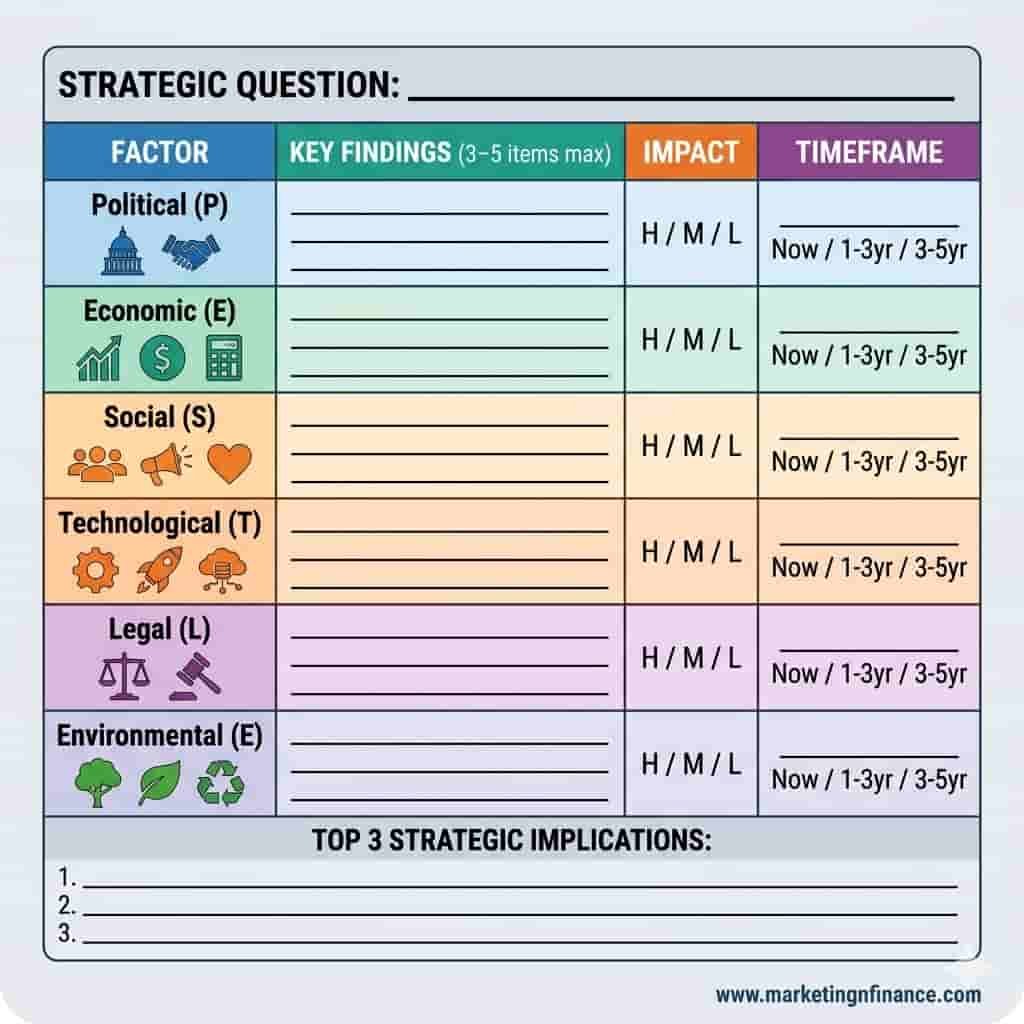
Use this template to structure your analysis. Complete each section before moving to the implications column.
How to Fill In Each Section
- Factor column: Work through each of the six categories in order. Do not skip any, even if one seems less relevant at first glance. You may discover important signals in unexpected categories.
- Key findings: Limit yourself to 3 to 5 items per factor. Longer lists dilute focus. If you have 12 points under Economic, force-rank them and keep only the highest-impact ones.
- Impact rating: Be honest. Not everything is high impact. Saving the “High” rating for genuinely material factors makes your prioritization meaningful.
- Timeframe: Label each factor as Now (already affecting operations), 1 to 3 years (medium-term planning horizon), or 3 to 5 years (long-term horizon requiring monitoring, not immediate action).
- Implications: This is the most important section. If you cannot draw a strategic implication from a factor, either the factor is not material enough to include, or you need more research to understand its significance.
PESTLE Analysis Examples (Real-World Business Contexts)
1. PESTLE Analysis Example: E-Commerce Business
Here is a condensed PESTLE analysis example for a mid-sized e-commerce retailer operating across the US and EU:
Political: US-China trade tariffs affecting supplier costs in electronics categories. EU digital services regulations adding compliance overhead for data-driven advertising.
Economic: Inflation reducing consumer discretionary spending. Strengthening US dollar improving margins on EU sales but reducing price competitiveness in European markets.
Social: Growing consumer preference for sustainable packaging. Shift toward mobile-first shopping accelerating, particularly in the 18–34 demographic.
Technological: AI-powered personalization tools reducing customer acquisition costs for early adopters. Rising cybersecurity threats targeting e-commerce payment infrastructure.
Legal: EU GDPR compliance requirements affecting data-driven retargeting. Consumer protection law updates in California requiring new product disclosure standards.
Environmental: Growing consumer demand for carbon-neutral delivery options. Packaging waste regulations tightening in France and Germany.
Top Strategic Implications:
- Diversify supplier base away from China to reduce tariff exposure (Political + Economic)
- Invest in mobile UX upgrades now to capture the demographic shift before it peaks (Social + Technological)
- Develop a carbon-neutral delivery option as a premium tier before regulation makes it mandatory (Environmental + Legal)
For a practical example of how a real business maps its external environment, see our British Airways SWOT Analysis, which covers how an international carrier navigates macro-environmental conditions across fuel prices, regulation, and competitive pressure simultaneously.
2. PESTLE Analysis Example: Startup Entering a New Market
A PESTLE analysis for a startup planning market entry is one of the highest-value applications of the framework because the cost of getting it wrong is existential.
Political: Target market has stable government but upcoming election could shift trade policy. Foreign direct investment regulations require local partner in certain sectors.
Economic: GDP growing at 4.2% annually but inflation at 7% compressing household spending on non-essentials. Strong local currency making imported components expensive.
Social: Young, educated, urban population with high smartphone penetration. Growing middle class with rising brand awareness and aspirations.
Technological: 4G infrastructure solid but 5G rollout two years behind projections. High mobile payment adoption reducing need for traditional retail infrastructure.
Legal: Data localization law requires customer data to be stored on local servers. Intellectual property enforcement inconsistent across jurisdictions.
Environmental: Government offering tax incentives for green product certifications. Consumer sentiment toward sustainability nascent but growing quickly among urban youth.
Top Strategic Implications:
- Require local data hosting architecture before launch to meet legal compliance from day one
- Price entry-level products aggressively to capture value-conscious consumers ahead of inflation plateau
- Apply for green certification now to qualify for government incentives and build early brand differentiation
4. Personal PESTLE Analysis
A personal PESTLE analysis applies the same macro-environmental scan to an individual’s career planning. While less common, it is highly effective for professionals navigating major career transitions or planning long-term skill development.
Political: Government investment in healthcare technology creating new roles in health-tech sector. Immigration policy changes affecting remote work regulations across target countries.
Economic: Rising demand for data professionals driving salary premiums of 20–30% above industry average. Recession risk in current employer’s sector increasing likelihood of restructuring.
Social: Remote-first work culture becoming standard in target companies. Growing emphasis on continuous learning and certifications over formal degree credentials.
Technological: AI automating parts of current role, reducing demand for junior positions. New cloud certification programs offering fast entry into higher-growth technical tracks.
Legal: Non-compete clauses in current contract limiting move to direct competitors for 12 months. Data privacy expertise becoming a standalone career path with clear certifications.
Environmental: Sustainability roles expanding as CSRD and ESG reporting obligations create demand for professionals who understand both business strategy and environmental impact.
Top Strategic Implications:
- Pursue cloud certification now to transition into a higher-growth technical track before AI erodes the current role further
- Target health-tech sector for next role given government investment tailwinds
- Begin networking outside the current employer’s sector to reduce exposure to restructuring risk
Common PESTLE Analysis Mistakes (and How to Fix Them)
Mistake 1: Starting Without a Strategic Question
A PESTLE without a guiding question produces a list of environmental facts with no analytical direction. Every external development is technically relevant to any business. The question is what filters the important from the merely interesting.
Fix: Write the strategic question at the top of your template before any other work begins.
Mistake 2: Treating Factors as Isolated Boxes
Political decisions create economic ripple effects. Social trends drive technology adoption. Environmental pressures generate new legal requirements. PESTLE factors cannot be put into narrow categories or isolated boxes without losing the compound insights that often carry the most strategic weight.
Fix: After completing individual factor analysis, spend 30 minutes specifically mapping the connections between your highest-priority factors.
Mistake 3: Mixing Time Horizons
Putting an “ECB interest rate decision next week” in the same analysis section as “demographic shift through 2040” treats two entirely different types of information as equivalent. They require fundamentally different responses and planning approaches.
Fix: Label every factor with a timeframe. Separate near-term operational responses from medium-term planning implications and long-term strategic positioning.
Mistake 4: Skipping the Legal and Environmental Factors
Many teams complete a thorough Political, Economic, Social, and Technological scan and then treat Legal and Environmental as quick afterthoughts. This is increasingly costly. GDPR fines, carbon reporting obligations, and packaging regulations are not minor compliance details. They are material business risks.
Fix: Assign dedicated research ownership to Legal and Environmental factors before the session begins. Give them equal session time as the original four factors.
Mistake 5: No Output Beyond the Document
PESTLE analysis that does not translate into explicit strategic implications becomes a document rather than a decision. Completing the six-factor scan is only half the work. The other half is writing the three to five most important strategic responses those findings demand.
Fix: Require the team to write at least three explicit implications before the session ends. Assign an owner and a timeline to each.
Mistake 6: Treating It as a One-Time Exercise
The macro-environment changes continuously. A PESTLE completed during your annual planning cycle may be significantly outdated by mid-year if major regulatory, economic, or technological shifts occur.
Fix: Schedule quarterly check-ins and set triggers for unscheduled reviews (major elections, central bank rate decisions, significant regulatory announcements, or technology disruptions in your industry).
PESTLE Analysis vs Other Frameworks: When to Use Which
Understanding where PESTLE fits in the strategy toolkit helps you get more from it and avoid applying it to questions it was not designed to answer.
1. PESTLE vs SWOT Analysis
SWOT covers both internal factors (Strengths and Weaknesses) and external factors (Opportunities and Threats). PESTLE covers only external macro-environmental factors.
The two frameworks work best together rather than in competition. PESTLE analysis identifies risk factors for the SWOT analysis. Run a PESTLE scan first to populate the Opportunities and Threats quadrants of your SWOT with externally grounded evidence rather than internal group opinions.
For a full walkthrough of how to run a SWOT analysis and build a TOWS strategy matrix from the output, see our complete SWOT analysis guide.
2. PESTLE vs Porter’s Five Forces
Porter’s Five Forces analyzes competitive intensity within a specific industry: supplier power, buyer power, threat of new entrants, threat of substitutes, and rivalry among existing competitors. It is industry-level analysis.
PESTLE operates at the macro level, above the industry. Porter’s Five Forces tells you how competitive your industry is right now. PESTLE tells you what external forces are reshaping the conditions in which that competitive dynamic operates.
Use both: PESTLE first to understand the macro context, then Porter’s Five Forces to understand the industry-specific competitive structure within that context. For an example of how Porter’s frameworks connect to real-world business decisions, our Google Value Chain Analysis shows how macro-environmental context shapes internal value creation decisions.
3. PESTLE vs Ansoff Matrix
The Ansoff Matrix is a growth strategy tool that maps four pathways: market penetration, market development, product development, and diversification. It answers the question of how to grow.
PESTLE is an environmental scanning tool that answers the question of what external conditions you are growing into. Key points from a PESTLE analysis can be incorporated into frameworks such as Ansoff’s matrix to ground growth strategy decisions in external reality rather than internal assumptions.
Use PESTLE to inform which Ansoff quadrant carries the least external risk before committing to a growth direction. For a detailed look at Ansoff Matrix applications, our Ansoff Matrix guide covers how businesses map growth options against real market conditions.
4. PESTLE vs BCG Matrix
The BCG Matrix is a portfolio management tool. It evaluates business units or product lines by market share and market growth rate, categorizing them as Stars, Cash Cows, Question Marks, or Dogs.
BCG Matrix does not account for external environmental factors affecting competitive position. PESTLE provides exactly that missing layer. A product classified as a Cash Cow in the BCG Matrix may face significant environmental or legal threats that the matrix alone would never surface.
For examples of how the BCG Matrix applies to real company portfolios, see our Business Analysis and Modelling section, which includes BCG Matrix analyses for companies across multiple industries.
Limitations of PESTLE Analysis
Honest strategy practice requires acknowledging what PESTLE does not do well.
- It only covers the external macro-environment. PESTLE tells you nothing about your internal capabilities, competitive differentiation, or operational efficiency. A business could complete a perfect PESTLE and still have no idea whether it has the internal resources to respond to what the analysis reveals.
- It can generate information overload. Without strict prioritization, a PESTLE session quickly produces 40 or 50 environmental factors across six categories. When you have too many factors without clear prioritization, the analysis paralyzes decision-making instead of enabling it. The three to five item limit per category exists for this reason.
- It does not generate strategy on its own. PESTLE maps the territory. It does not tell you which path to take across it. Without a follow-through step that translates findings into explicit strategic implications, the analysis produces no decisions.
- It requires significant research to do well. A shallow PESTLE built on quick internet searches and group opinions delivers shallow strategy. Meaningful PESTLE analysis requires dedicated research time, access to quality data sources, and cross-functional expertise.
- Factors change faster than the analysis can be updated. In industries like financial services, technology, or energy, macro-environmental conditions can shift materially in weeks. No framework can guarantee currency. The quarterly review cadence exists to reduce this limitation but cannot eliminate it entirely.
Frequently Asked Questions
What does PESTLE stand for?
PESTLE stands for Political, Economic, Social, Technological, Legal, and Environmental. Each letter represents one category of external macro-environmental factor that can affect an organization’s strategy, operations, and performance.
What is the purpose of a PESTLE analysis?
The purpose of a PESTLE analysis is to give organizations a structured, comprehensive view of the external macro-environment before making major strategic decisions. It identifies external opportunities to act on and external threats to prepare for, based on verifiable data rather than internal assumptions.
How do you do a PESTLE analysis step by step?
Define a strategic question first. Assign research ownership to each of the six factors. Gather data from verified external sources. Rate each factor by impact and timeframe. Map the connections between related factors. Translate findings into explicit strategic implications. Review quarterly or after major external events.
What is the difference between PESTLE and SWOT analysis?
SWOT covers both internal factors (Strengths, Weaknesses) and external factors (Opportunities, Threats). PESTLE covers only external macro-environmental factors across six specific categories. The two frameworks work best together: PESTLE feeds into the Opportunities and Threats quadrants of a SWOT with externally grounded evidence.
What is the difference between PESTLE and PESTEL?
PESTLE and PESTEL are the same framework. The only difference is the letter order of the acronym. In PESTLE, Legal comes before Environmental. In PESTEL, Environmental comes before Legal. Both cover the same six factors and apply the same analytical approach.
How often should a PESTLE analysis be updated?
Most organizations should update their PESTLE analysis at least annually, with quarterly check-ins in fast-moving industries. An unscheduled review is warranted after any major external event: a significant regulatory change, an election outcome that shifts policy, a major technological disruption, or a sharp economic shift.
When should you use a PESTLE analysis instead of Porter’s Five Forces?
Use PESTLE when you need to understand the broad macro-environmental conditions shaping your industry. Use Porter’s Five Forces when you need to analyze competitive dynamics within a specific industry. The two tools complement each other: PESTLE provides the macro context, and Porter’s Five Forces maps the competitive structure within that context.
Can individuals use a PESTLE analysis for personal career planning?
Yes. A personal PESTLE analysis applies the same six-factor scan to an individual’s career environment. Political factors might include immigration policy or government investment in specific sectors. Economic factors cover salary trends and recession risk. Social factors include workplace culture shifts. Technological factors cover automation threats to your current role. Legal factors might include non-compete clauses. Environmental factors include the growth of sustainability-related career paths. It is a useful tool for anyone planning a significant career transition.
Conclusion
A PESTLE analysis gives organizations the external clarity that internal strategy tools cannot provide on their own. It forces structured thinking about six categories of forces that every business must navigate but that most teams only address reactively.
Studies show companies using PESTLE analysis are 2.3 times more likely to successfully navigate market changes than those operating without a formal external scanning process. That advantage compounds over time because better environmental awareness leads to better resource allocation, faster threat recognition, and more credible market entry decisions.
The difference between a PESTLE that collects dust and one that shapes strategy comes down to three things: a clear strategic question before you start, real data supporting each factor, and explicit strategic implications that assign ownership and timelines to every response.
To see how PESTLE connects to other strategy frameworks in practice, explore the full suite of business analysis tools covered in our Business Analysis and Modelling section, where we break down strategic frameworks applied to real companies across industries.