
| A SWOT analysis is a strategic planning tool that helps you evaluate the strengths, weaknesses, opportunities, and threats of a business, project, or goal. It separates internal factors you control from external forces you must respond to. Teams use it to make smarter decisions, prioritize actions, and build plans grounded in reality rather than guesswork. |
What is a SWOT Analysis? (Definition & Origin)
A SWOT analysis is a structured framework that maps four key factors in one visual grid. Two factors sit inside your organization (strengths and weaknesses). Two factors come from the outside world (opportunities and threats). Together, they give you a complete picture of where you stand before you decide where to go.
The tool remains one of the most widely practiced strategy frameworks in the world. According to research, 84% of successful businesses use SWOT analysis regularly to identify challenges and competitive advantages. Its staying power comes from simplicity. You do not need advanced training or expensive software to run one effectively.
Where Did SWOT Analysis Come From?
The framework is historically credited to Albert Humphrey, who worked at the Stanford Research Institute during the 1960s and 1970s. His team used data from Fortune 500 companies to understand why corporate planning kept failing. The goal was to find a simple way to organize what was working, what was not, and what external forces were shaping outcomes.
The acronym SWOT itself evolved from an earlier framework called SOFT Analysis (Satisfactory, Opportunity, Fault, Threat). Over the following decades, SWOT became a standard tool taught in business schools and used across every industry imaginable.
Internal vs External Factors Explained
Understanding this distinction is critical before you begin.
Internal factors are things you control directly:
- Strengths: what your organization does well right now
- Weaknesses: areas where you fall short compared to others
External factors are conditions in the market or environment that you cannot fully control:
- Opportunities: trends or gaps you can act on
- Threats: forces that could harm your position
Getting this separation right is what separates a useful SWOT from a confused one. Many beginners accidentally mix internal and external factors, which leads to a muddled strategy. We cover how to avoid that in the mistakes section below.
The 4 Components of SWOT: A Deep Dive
1. Strengths: What to Look For (With Examples)
Strengths are the internal advantages your organization already holds. They give you an edge over competitors or help you deliver more value to customers.
Strong SWOT analysis examples of strengths include:
- A proprietary product or technology that rivals do not have
- A loyal customer base with high Net Promoter Scores
- Strong financial reserves that allow investment during downturns
- Recognized brand reputation in a specific market
- A skilled, experienced leadership team
The key rule for strengths: back them with data. Saying “we have great customer service” is an opinion. Saying “our NPS score is 72, which is 18 points above the industry average” is a strength. Research consistently shows that SWOTs built on facts produce far better strategies than those built on group sentiment.
2. Weaknesses: How to Be Honest Without Bias
Weaknesses are internal factors that put you at a disadvantage. They are the hardest part of the exercise because people do not want to admit shortcomings in front of colleagues or managers.
Common business weaknesses include:
- High employee turnover in critical departments
- Outdated technology or infrastructure
- Limited marketing budget compared to competitors
- Over-reliance on a single product, client, or revenue stream
- Gaps in product features that customers regularly request
The goal here is not to be harsh. It is to be accurate. One of the most common SWOT analysis mistakes is underestimating weaknesses because nobody wants to highlight failures in a group setting. A practical fix is to ask everyone to list weaknesses privately before sharing with the group. This reduces social pressure and surfaces more honest input.
3. Opportunities: Spotting External Growth Vectors
Opportunities are external conditions that your organization can act on to grow, improve, or gain competitive ground. They are not things you create; they are things that exist in the market that you can respond to.
Good opportunity examples for a SWOT analysis for a business include:
- A competitor shutting down or losing market share
- A new regulation that favors your product type
- A shift in consumer behavior toward something you already offer
- An emerging geographic market that is currently underserved
- New technology that could reduce your production costs
The important discipline here is separating opportunities from strengths. “We could launch a new product” is not an opportunity unless there is external market evidence that demand exists for it.
4. Threats: Mapping Competitive and Market Risks
Threats are external forces that could harm your position, reduce your revenue, or make your current strengths irrelevant.
Common threats in a SWOT analysis include:
- A well-funded competitor entering your market
- Economic downturns that reduce consumer spending
- Regulatory changes that raise your compliance costs
- Supply chain disruptions affecting your delivery timelines
- Changing customer preferences, moving away from your product category
When identifying threats, focus on what is actually happening in your market, not theoretical worst-case scenarios. The goal is to identify real risks so you can plan responses in advance.
How to Conduct a SWOT Analysis: Step by Step
Step 1: Define Your Objective
This is the step that most guides skip entirely, and it is the one that determines whether your SWOT produces useful output or wasted effort.
Before you write a single bullet point, you need to answer: What decision is this SWOT analysis helping me make?
The objective could be:
- Should we enter a new market?
- Should we launch this specific product?
- How do we improve our competitive position over the next 12 months?
A SWOT without a clear objective becomes a general brainstorm with no actionable direction. It ends up being a long list of obvious points that nobody acts on.
Step 2: Gather Data (Not Just Opinions)
This step separates a data-first SWOT from an opinion-driven one. Before your team sits down together, gather hard evidence for each quadrant.
Sources to pull from:
- Strengths: financial reports, customer reviews, NPS data, employee retention rates, sales figures
- Weaknesses: customer complaint logs, churn data, operational efficiency reports, employee surveys
- Opportunities: market research reports, competitor press releases, industry trend data, government policy changes
- Threats: competitor analysis, economic forecasts, regulatory updates, technology disruption reports
When you arrive at the session with real data, you stop debating opinions and start building a strategy. Businesses that ground their SWOT analysis in facts rather than perceptions avoid the most common failure mode of the framework.
Step 3: Run the Brainstorm Session
With your objective clear and your data gathered, bring your team together. Keep the group focused and manageable. Workshops with 15 people tend to produce noise. A focused group of 4 to 6 people with diverse perspectives produces better outputs.
For each quadrant, work through your pre-gathered data first. Then open the floor for additional insights. Use the objective as a filter: if a point does not relate to the decision you are trying to make, it does not belong in this SWOT.
Limit each quadrant to 3 to 5 items. This forces prioritization and keeps the analysis useful. A SWOT with 20 bullets per quadrant is not more thorough; it is less actionable.
Step 4: Prioritize and Score Each Factor
Once your four quadrants are populated, not every item deserves equal attention. Rate each factor on two dimensions: its potential impact (high, medium, low) and the likelihood or urgency of that factor.
Focus your strategy on high-impact, high-likelihood items first. This separates what is critical from what is merely interesting.
Step 5: Build a TOWS Matrix to Generate Strategy
This is the step that almost no guide covers, and it is the most important one. A completed SWOT gives you organized information. A TOWS matrix turns that information into an actual strategy.
The TOWS matrix crosses your four quadrants to generate four types of strategies:
| Opportunities (O) | Threats (T) | |
| Strengths (S) | SO Strategies: Use strengths to capture opportunities | ST Strategies: Use strengths to reduce the impact of threats |
| Weaknesses (W) | WO Strategies: Fix weaknesses by tapping into opportunities | WT Strategies: Minimize weaknesses to avoid being hurt by threats |
Example: A startup with a strong technology platform (Strength) sees that enterprise clients are underserved in their category (Opportunity). The SO strategy is to create an enterprise-tier product and market it directly to decision-makers in that segment.
Without the TOWS matrix, your SWOT is a snapshot. With it, your SWOT becomes a roadmap.
SWOT Analysis Examples (Real-World Contexts)
1. Business SWOT Example
Here is a condensed SWOT analysis example for a mid-sized e-commerce company:
- Strengths: Strong direct-to-consumer email list (450k subscribers), proprietary fulfillment software, 4.7-star average review rating.
- Weaknesses: No physical retail presence, high customer acquisition cost, limited product range compared to Amazon.
- Opportunities: Rising consumer preference for sustainable packaging, growing demand in Southeast Asian markets, and the subscription commerce trend.
- Threats: Amazon expanding into adjacent categories, rising ad costs on Meta and Google, and supply chain delays from key manufacturers.
SO Strategy: Launch a sustainable packaging line and market it through the email list to the existing customer base, who already trust the brand.
WT Strategy: Reduce dependency on paid ads by building organic search traffic, which lowers acquisition cost and reduces exposure to rising platform costs.
You can see a detailed real-world application in our British Airways SWOT Analysis, which walks through how a major airline maps its internal capabilities against volatile external conditions.
2. Startup SWOT Example
Businesses using SWOT are 2.8x more likely to achieve their strategic goals compared to those without a structured planning process. For startups, this matters especially because resources are tight and every strategic decision carries high stakes.
A SWOT analysis for a startup company should focus on what the founding team genuinely controls (product, network, speed) versus what the market is doing (investor appetite, competitor funding, regulatory environment).
- Strengths: Founding team with 10+ years of industry experience, proprietary dataset, early product-market fit signals.
- Weaknesses: Limited cash runway (8 months), no enterprise sales experience, and small brand awareness.
- Opportunities: Enterprise clients are dissatisfied with current legacy solutions, two key competitors are being acquired (creating customer confusion), government grants available for tech startups in this sector.
- Threats: A Series B competitor just raised $40M, data privacy regulations tightening in key markets, economic slowdown reducing enterprise software budgets.
3. Personal SWOT Analysis Example
A SWOT analysis is not only for businesses. A personal SWOT analysis applies the same four-quadrant thinking to career planning, job searches, or professional development goals.
- Strengths: Five years of data analytics experience, strong SQL and Python skills, two published case studies.
- Weaknesses: No management experience, limited public speaking practice, and no network in the target industry.
- Opportunities: High demand for data professionals in the healthcare sector, a mentorship program opening at a target company, and three industry conferences coming up this quarter.
- Threats: AI tools are automating parts of the current role, three other candidates in the final round with more domain expertise, and a budget freeze at the current employer limiting promotion options.
This kind of personal SWOT analysis helps professionals stop drifting and start planning with intention.
4. Nonprofit SWOT Example
Nonprofits use SWOT to align programs with funding realities and community needs.
- Strengths: 12-year track record in the community, strong volunteer network, trusted relationships with local government.
- Weaknesses: Over-reliance on one major grant (62% of budget), limited digital presence, no dedicated fundraising staff.
- Opportunities: Corporate social responsibility budgets are growing in the region, and a new federal grant program is opening for community health initiatives.
- Threats: Competing nonprofit launched a similar program, a major donor is considering redirecting funds, and the cost of program delivery is rising with inflation.
For nonprofits, the WO strategy is often the most valuable: fixing the over-reliance on one funder by actively pursuing the new grant and corporate sponsorship opportunities before the next budget cycle.
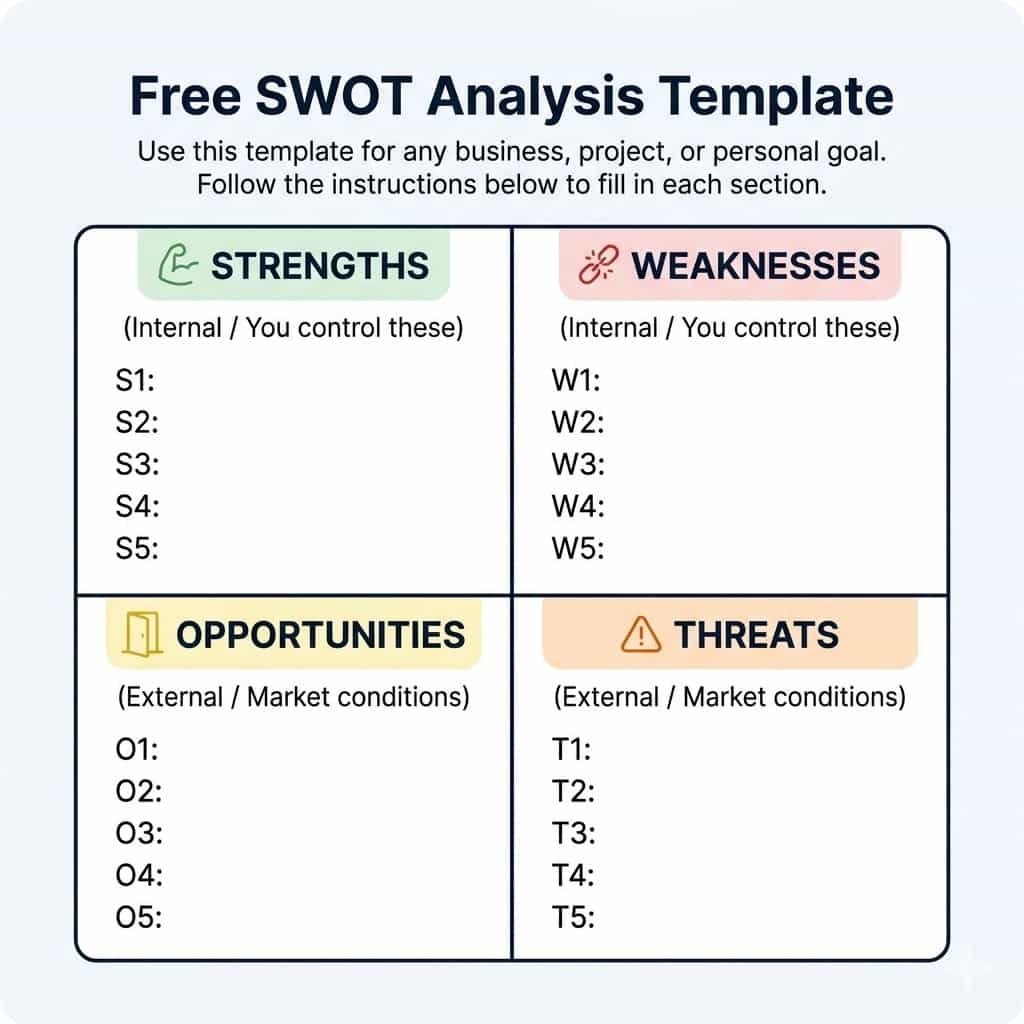
Free SWOT Analysis Template
How to Fill It In (Field-by-Field Guide)
Strengths fields (S1-S5): Write only items backed by data. Ask: “Can I prove this with a number, a review, or a report?” If yes, include it.
Weaknesses fields (W1-W5): Be specific. “Poor marketing” is too vague. “Customer acquisition cost is 40% above industry benchmark” is actionable.
Opportunities fields (O1-O5): Each item must be external. If it comes from something you control, it belongs in strengths, not here.
Threats fields (T1-T5): Focus on threats that are likely and near-term. Theoretical catastrophes belong in a risk register, not your SWOT.
Once all four quadrants are complete, move to the TOWS matrix from Step 5 above to turn your analysis into a strategy.
7 Common SWOT Mistakes (and How to Fix Them)
Understanding what a SWOT analysis is does not automatically mean you will run one well. These are the seven mistakes that consistently derail the process.
Mistake 1: No clear objective. Without a specific decision to guide the exercise, teams generate long lists of obvious points that produce no action.
Fix: Write the objective at the top of the template before you begin.
Mistake 2: Opinions over evidence. SWOT analysis filled with perceptions instead of data produces an unreliable strategy.
Fix: require that every item be backed by at least one data point or source.
Mistake 3: Too many items per quadrant. Lists of 15 weaknesses and 20 opportunities are not more thorough. They bury the critical factors under noise.
Fix: limit each quadrant to 3 to 5 items. Force your team to prioritize.
Mistake 4: Mixing internal and external factors. A very common mistake is overlapping strengths with opportunities and weaknesses with threats.
Fix: always ask “do we control this?” If yes, it is internal. If no, it is external.
Mistake 5: Treating it as a one-time exercise. A SWOT done in January that is never reviewed becomes useless by April. SWOT should be a dynamic tool that evolves with the business environment.
Fix: Schedule a review every six months or immediately after any major market event.
Mistake 6: No follow-through to action. The most common reason SWOT analysis fails is that the output stays in a slide deck.
Fix: connect your SWOT to a TOWS matrix and assign owners and deadlines to each strategy generated.
Mistake 7: Groupthink dominating the session. Senior leaders speaking first shuts down honest input from the rest of the team.
Fix: Collect individual responses anonymously before the group session, then synthesize as a team.
SWOT vs Other Frameworks: When to Use Which
Knowing how to do a SWOT analysis is useful. Knowing when not to use it is equally important. These are the most common comparisons.
1. SWOT vs PESTLE
PESTLE (Political, Economic, Social, Technological, Legal, Environmental) is a purely external scan. It does not look at internal factors at all. Use PESTLE when you need a deep read of the macro-environment before a major strategic decision. Use SWOT when you need to combine internal and external factors into one planning view.
The two frameworks complement each other well. Many teams run a PESTLE analysis first to map the external environment thoroughly, then feed those findings into the Opportunities and Threats quadrants of their SWOT.
2. SWOT vs Porter’s Five Forces
Porter’s Five Forces examines competitive intensity across five dimensions: threat of new entrants, bargaining power of suppliers, bargaining power of buyers, threat of substitutes, and rivalry among existing competitors. It is specifically focused on industry structure and competitive dynamics.
Use Porter’s Five Forces when your primary question is “how competitive is this industry?” Use SWOT when your question is broader: “Where do we stand, and what should we do next?”
For a deeper look at how strategic frameworks apply to real companies, our Ansoff Matrix guide shows how growth strategy decisions connect to your competitive position.
3. SWOT vs OKRs
OKRs (Objectives and Key Results) are not a diagnostic tool. They are a goal-setting and execution framework. SWOT tells you where you are. OKRs tell you where to go and how to measure progress.
The ideal sequence is: run a SWOT analysis first, build your TOWS strategies, then translate those strategies into OKRs with specific targets and timelines. This chain connects diagnosis to execution in a way that neither tool achieves alone.
Limitations of SWOT Analysis
Honest strategic thinking requires acknowledging what SWOT does not do well. These limitations are real, and ignoring them leads to overconfidence in the output.
- It is static by nature. A SWOT captures a moment in time. Markets shift. Competitors pivot. A SWOT analysis completed six months ago may no longer reflect your current situation. Treat it as a living document, not a finished report.
- It encourages opinions over data. Without deliberate effort to ground each factor in evidence, SWOT sessions quickly become opinion contests. The widespread popularity of SWOT has led many organizations to use it without gathering meaningful insights, producing shallow strategies that fail in practice.
- It does not prioritize on its own. SWOT tells you what exists. It does not tell you what matters most. Two teams looking at the same SWOT can walk away with completely different strategy priorities if they do not add a scoring or prioritization step.
- It can create an internal focus problem. SWOT analysis can make organizations overly self-absorbed, focusing on internal factors when they should first understand external opportunities and threats. Starting with the external scan (Opportunities and Threats) before looking inward often produces sharper insights.
- It does not suggest action. SWOT is a diagnostic tool, not a prescriptive one. This is exactly why the TOWS matrix step is essential. SWOT without TOWS is analysis without strategy.
For a practical look at how these limitations play out in real company analysis, see how we approach the Google Value Chain Analysis and how multiple frameworks work together to build a complete strategic picture.
Frequently Asked Questions
What does SWOT stand for?
SWOT stands for Strengths, Weaknesses, Opportunities, and Threats. Strengths and weaknesses are internal factors a business controls, while opportunities and threats are external forces in the market or environment.
What is the purpose of a SWOT analysis?
A SWOT analysis helps organizations identify their competitive position, surface blind spots, and prioritize strategic actions. It aligns internal capabilities against external market realities before major decisions are made.
How do you conduct a SWOT analysis step by step?
Define a clear objective, gather data from multiple sources, brainstorm each quadrant with your team, limit each section to 3 to 5 evidence-backed factors, prioritize items by impact, and translate findings into a TOWS strategy matrix.
What is the difference between strengths and opportunities in SWOT?
Strengths are internal advantages you already control, such as skilled staff or proprietary technology. Opportunities are external conditions you can act on, such as an emerging market or a competitor’s decline.
When should you NOT use a SWOT analysis?
SWOT is least effective when you need quantitative depth, a detailed external scan (use PESTLE instead), or competitive force mapping (use Porter’s Five Forces). It also fails when treated as opinion-driven brainstorming without data to support each claim.
How often should a SWOT analysis be updated?
Most businesses should revisit their SWOT every 6 to 12 months, or immediately after a major market event, product launch, or organizational change. Treating it as a one-time exercise is one of the most common strategic mistakes.
What is the TOWS matrix and how does it relate to SWOT?
The TOWS matrix takes your completed SWOT and generates four strategy types: SO (use strengths to capture opportunities), ST (use strengths to counter threats), WO (fix weaknesses using opportunities), and WT (minimize weaknesses to avoid threats). It turns analysis into action.
Can you do a SWOT analysis for a person, not just a business?
Yes. A personal SWOT analysis applies the same four quadrants to an individual’s career or goals, assessing skills and traits (internal) against job market conditions and competition (external). It is widely used in career planning and professional development.
Conclusion
A SWOT analysis is one of the most enduring tools in strategic planning because it forces clarity. It makes you separate what you control from what you cannot. It asks you to be honest about weaknesses. And when combined with a TOWS matrix, it turns a 2×2 grid into a practical strategy roadmap.
SWOT is used not just in corporations but also in nonprofits, government bodies, and even personal career planning because its structure adapts to virtually any planning challenge.
The difference between a SWOT that gathers dust and one that drives decisions comes down to three things: a clear objective before you start, real data instead of group opinion, and a TOWS follow-through that assigns ownership to every strategy generated.
To see SWOT in action across different company types, explore our Business Analysis and Modelling section where we break down real-world strategy frameworks applied to companies across industries.